Evaluation
AI evaluation and reliability
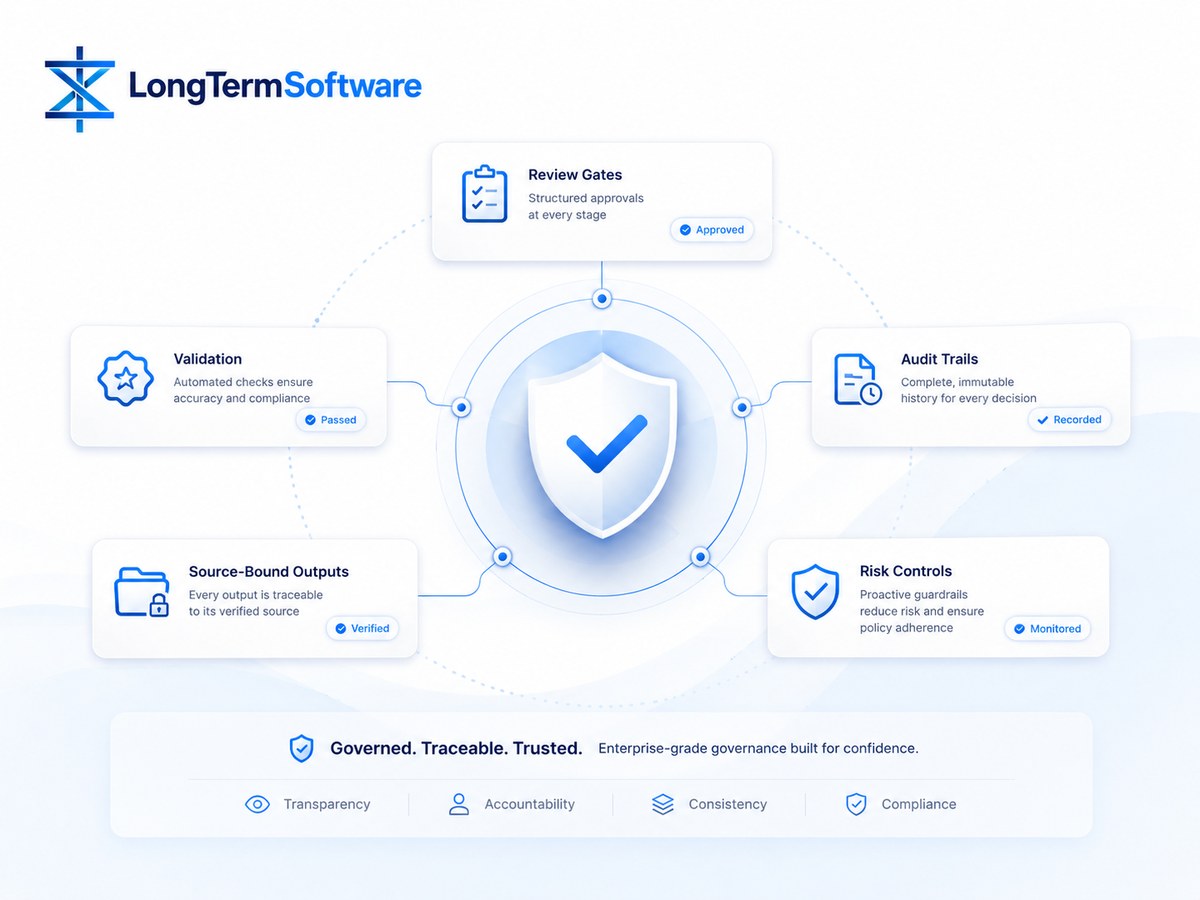
Define rubrics, gold-answer sets, blocked-action logs, fallback rules, and release gates before expanding AI use.
Proof detail
AI pilots need measurable release gates before scaling.
This proof item exists to route a public claim to a narrower supporting artifact. It is not a certification, guarantee, vendor partnership claim, or autonomous execution authority.
Primary supporting route: /case-studies/ai-evaluation-reliability/
Boundary: Evaluation support is not a safety certification.
Review posture
- Source-bound claim language
- Human review before claim widening
- Public-safe narrative where marked
- No AGI, consciousness, certification, or partner overclaim
Proof maturity
- Public-safe narrative: A buyer-readable case or proof path that avoids private client code, data, metrics, or confidential workflow details.
- Artifact preview: A sample deliverable, ledger, checklist, proposal packet, or workflow diagram that shows how the work is structured.
- Needs approved outcome data: A proof route that is intentionally conservative until a client-safe metric, quote, or before/after result is approved.
- Machine-readable evidence: JSON, CSV, llms.txt, or manifest data intended for technical reviewers, AI agents, and procurement tooling.
Evidence artifacts
- AI evaluation case narrative
- evaluation/reliability one-pager
- blocked-action and drift-check sample artifacts
Controls
- rubrics
- gold-answer sets
- drift checks
- blocked-action logs
- fallback criteria
Related visual

Next step
Start with a short fit call, then scope the assessment.
The first conversation should decide whether the next step is a fixed-scope assessment, modernization blueprint, governed AI pilot, or reliability review.
Book a 20-minute fit call