Public-safe narrative
A buyer-readable case or proof path that avoids private client code, data, metrics, or confidential workflow details.
Use it for early trust and service fit, then request private review for client-specific detail.
LongTermSoftware.com
A source-backed proof map showing how LongTermSoftware keeps public claims tied to evidence, case paths, and boundary notes.
Proof taxonomy
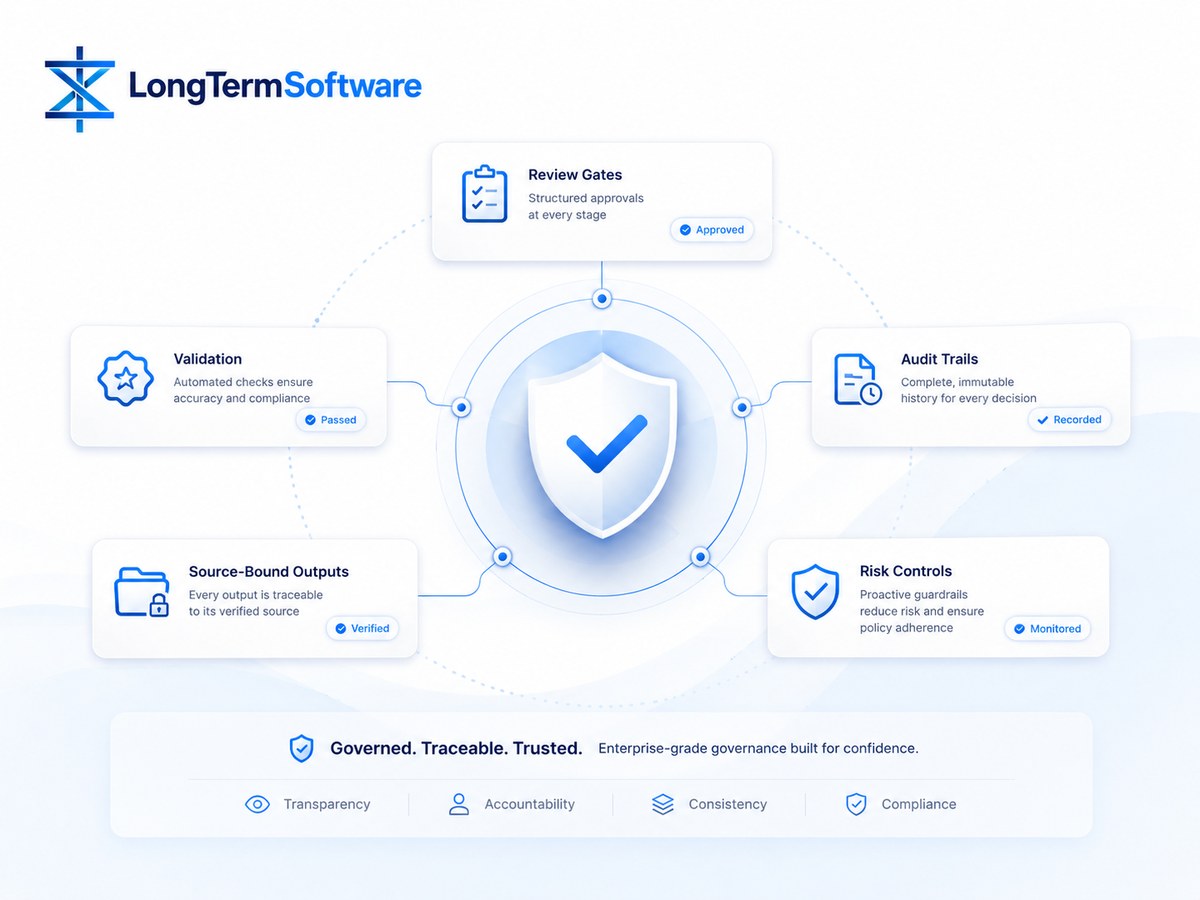
LongTermSoftware keeps public claims bounded by separating narratives, sample artifacts, approved outcomes, private evidence, and machine-readable routes.
| Claim type | Public? | Machine-readable? | Buyer use | Boundary |
|---|---|---|---|---|
| Public-safe narrative | Yes | Sometimes | Understand environment, risk, approach, controls, and artifacts | Not an approved client outcome |
| Sample artifact | Yes | Sometimes | Inspect deliverable structure before buying | Contains no client data and proves no production result |
| Approved outcome | Only when supplied and approved | Where appropriate | Evaluate demonstrated result | Exact source and wording control the claim |
| Private evidence | No | No public export | Secure due diligence under agreed handling | Not available through public routes |
| Machine-readable evidence | Yes | Yes | Procurement, crawler, and technical review | Does not grant execution authority or certification |
Claim-to-evidence ledger
Use the human-readable ledger first, then follow the route or structured export when deeper inspection is needed.
A buyer-readable case or proof path that avoids private client code, data, metrics, or confidential workflow details.
Use it for early trust and service fit, then request private review for client-specific detail.
A sample deliverable, ledger, checklist, proposal packet, or workflow diagram that shows how the work is structured.
Use it to judge delivery quality before engaging.
A proof route that is intentionally conservative until a client-safe metric, quote, or before/after result is approved.
Do not treat it as a published client result until the status changes.
JSON, CSV, llms.txt, or manifest data intended for technical reviewers, AI agents, and procurement tooling.
Use it to compare public claims against structured evidence routes.
Claim
Proof
Legacy modernization and parity proof route.
Type
Case study
Claim
Proof
AI documentation review proof route.
Type
Case study
Claim
Proof
Governed knowledge / RAG proof route.
Type
Project proof
Claim
Proof
.uai memory and docs proof route.
Type
Memory artifact
Claim
Proof
AI evaluation and reliability proof route.
Type
Method proof
Claim
Proof
llms.txt, AI manifest, and route QA contract proof route.
Type
Machine-readable asset
Private evidence review
Where approved and relevant, private code, architecture, system evidence, or outcome detail can be reviewed under the appropriate confidentiality and access boundary. Public pages do not imply that every private artifact is available.
Next step
The first conversation should decide whether the next step is a fixed-scope assessment, modernization blueprint, governed AI pilot, or reliability review.
Book a 20-minute fit call