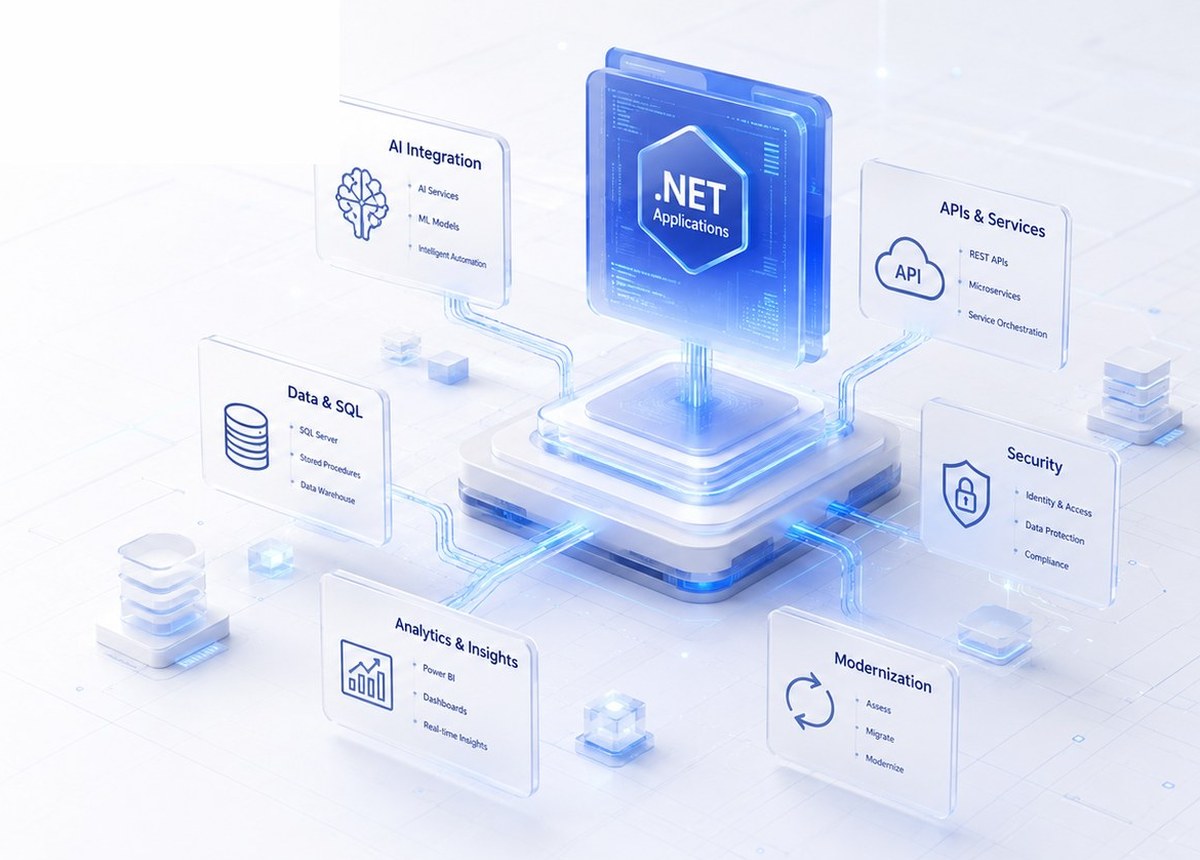
Modernize Legacy .NET and SQL Systems Without Behavioral Drift
LongTermSoftware helps teams make hidden behavior visible before a rewrite, define safer modernization seams, and build AI workflows that keep evidence, reviewers, and downstream authority under control.
Enterprise modernization and AI workflow architecture with reviewable boundaries.
Web Forms · Classic ASP · VB.NET · ASP.NET · SQL ServerStored-procedure and undocumented business-rule riskGoverned RAG and reviewer applicationsNo autonomous production authority by default
Who we help
Call before a rewrite or AI rollout when the system cannot casually change
These are the situations where a fixed-scope assessment, blueprint, pilot, or evaluation program can reduce decision risk.
Legacy .NET and SQL systems
Buyer risk: A working system is expensive to change because behavior is buried across code, forms, reports, and data rules.
Response: Map current behavior and regression risk before choosing a rewrite, strangler seam, or migration sequence.
Make fragile software and AI-assisted work easier to inspect, change, and govern
The commercial promise stays concrete: preserve important behavior, keep AI reviewable, and make proof available at the level each stakeholder needs.
Preserve the rules that keep the business running.
Map hidden SQL, reporting, approval, and UI behavior before modernization so new services can be compared against current production behavior.
Use AI where it helps, and block it where it should not decide.
Design AI workflows with explicit evidence, reviewer states, fallback rules, blocked actions, and bounded downstream authority.
Make every important claim point to something inspectable.
Use scoped assessments, public-safe artifacts, case narratives, machine-readable ledgers, and clear boundary notes instead of unsupported marketing language.
Solution guides
Research the buyer problem before choosing a package
These guides use conventional enterprise search language. The service pages remain the source of current scope, pricing, deliverables, and commercial boundaries.
Legacy Software Modernization Consulting
Modernize brittle .NET, SQL Server, Web Forms, Classic ASP, and VB.NET systems by mapping current behavior, hidden business rules, service seams, parity tests, and staged release decisions.
Get principal-led support for aging .NET and SQL systems, recurring architecture decisions, database risk review, testing strategy, delivery repair, and modernization governance.
AI Production Readiness and Reliability Consulting
Evaluate AI workflows with representative test sets, source-support and refusal checks, blocked-action tracking, reviewer agreement, drift monitoring, release thresholds, and rollback rules.
A modernization plan for brittle .NET, SQL Server, Web Forms, Classic ASP, VB.NET, or stored-procedure-heavy systems that cannot casually change behavior.
A knowledge foundation for documents, SOPs, policies, code notes, and support content that need provenance and trust labels, not generic vector sprawl.
A reviewable internal AI app such as a documentation reviewer, analyst assistant, triage workbench, or migration-note reviewer with typed UI and audit trails.
A clear buying sequence before sensitive system access
The first conversation stays low-friction. Detailed evidence and private system access move into the right channel only after fit and scope are clear.
01
Fit call
Confirm whether the problem matches the service model without asking for secrets, source code, PHI, or private production data.
02
System and context intake
Identify system types, business owners, known risk, evidence access, and secure-channel needs.
03
Assessment or package kickoff
Define scope, artifacts, responsibilities, timeline, acceptance criteria, and explicit exclusions.
04
Artifact review
Review maps, risks, test gaps, workflow controls, evidence, and unresolved questions with the right stakeholders.
05
Next-step decision
Proceed to a blueprint, pilot, implementation, evaluation program, retainer, or no further work based on the evidence.
Do not submit through public forms: secrets, credentials, private source code, PHI, customer records, financial account data, or confidential production architecture.
Proof before purchase
Review business narratives, technical paths, sample artifacts, and machine-readable evidence
Public pages distinguish methods and sample artifacts from approved client outcomes so a buyer can understand what each proof surface does and does not establish.
Business-impact narrative
Problem, risk, intervention, controls, artifact preview, and approved outcome or decision. This is the format for non-technical stakeholders.
AI output does not automatically become an operational action
Controls are selected for the actual workflow and risk. Public materials do not claim certification, universal safety, or autonomous production authority.
Review before high-impact use
Generated drafts, recommendations, classifications, and summaries do not automatically become production actions.
Explicit source boundaries
Each workflow identifies which sources are allowed, what evidence must be visible, and when an answer should refuse or escalate.
Secure handling for sensitive environments
Public forms and diagnostics must not receive secrets, credentials, PHI, private code, or regulated records; sensitive work moves to an approved private channel.
Least-authority integration
A workflow receives only the access required for its bounded task, with privileged writes and irreversible actions gated separately.
Audit and blocked-action evidence
Important review decisions, rejections, blocked actions, and escalation paths should be observable and exportable.
Model choice follows the risk profile
Local, private, or managed model options are selected after data, integration, latency, cost, and governance constraints are understood.
Public-safe narrative tied to source-governed memory, LLMWikis/AIWikis, and UAIX-style handoff themes; approved outcome data can be added when supplied.
Governed knowledge system for internal teams
A public-safe case path for replacing scattered prompt residue with source-governed knowledge and retrieval.
Risk: Generic retrieval can mix unapproved drafts with authoritative knowledge and produce answers that are hard to audit.
Control: trust labels
Value: More reliable internal search and AI assistance with clearer provenance and lower hallucination risk.
Use a checklist or local diagnostic before a sales conversation.
Each major resource now has a human-readable landing page that explains who should use it, how to use it, what it does not prove, and which service or case it supports.
A buyer and technical-team checklist for deciding whether an AI use case has clear sources, owners, review boundaries, and measurable value before tool selection.
What technical buyers and executive sponsors ask before a fit call
The answers stay plain-language and do not widen public claims beyond the evidence available.
What does behavior-preserving modernization mean?
It means documenting the current system’s observable inputs, outputs, calculations, permissions, workflow states, and exceptions so intentional changes can be separated from accidental behavioral drift.
Do you rewrite legacy systems from scratch?
Not by default. The preferred path is to map risk, introduce testable seams, and modernize in bounded stages when that reduces operational risk.
What kinds of .NET systems are a fit?
Common fits include ASP.NET, ASP.NET Core, MVC, Web Forms, Classic ASP, VB.NET, C#, SQL Server, stored-procedure-heavy systems, reporting workflows, internal admin tools, and API modernization.
What if our business logic is mostly in SQL Server?
SQL-side business rules are treated as part of the application behavior. The modernization work maps stored procedures, jobs, reports, transactions, owners, and representative parity scenarios before replacement.
Can you help with AI without exposing private data?
Yes, when the engagement is designed around approved data boundaries, secure channels, least-authority access, and an appropriate local, private, hybrid, or managed model approach. Public forms must not receive secrets or regulated data.
What is human-reviewed AI?
AI output remains proposed work until a named reviewer can inspect evidence, edit, approve, reject, block, or escalate it under explicit workflow rules.
What is governed RAG?
Governed RAG adds source ownership, access control, provenance, content states, citation rules, refusal behavior, evaluation, and human escalation around retrieval.
What happens after the first fit call?
If the problem fits, the next step is usually a scoped assessment or package proposal. Sensitive system details move to an approved private channel rather than the public form.
Do you publish client metrics?
Only when the source material and exact wording are approved. Public-safe case pages distinguish methods, sample artifacts, measurement models, and approved outcomes so templates are not presented as client results.
How do you handle confidential systems?
Public routes collect only high-level context. Private code, credentials, PHI, customer records, and confidential architecture require a separately approved secure handling path.
Next step
Start with a short fit call before sending sensitive system details.
If the problem fits, the next step is a fixed-scope package with named artifacts, boundaries, responsibilities, and acceptance criteria.