
Solution guide
Human-in-the-Loop AI Workflows for High-Impact Enterprise Work
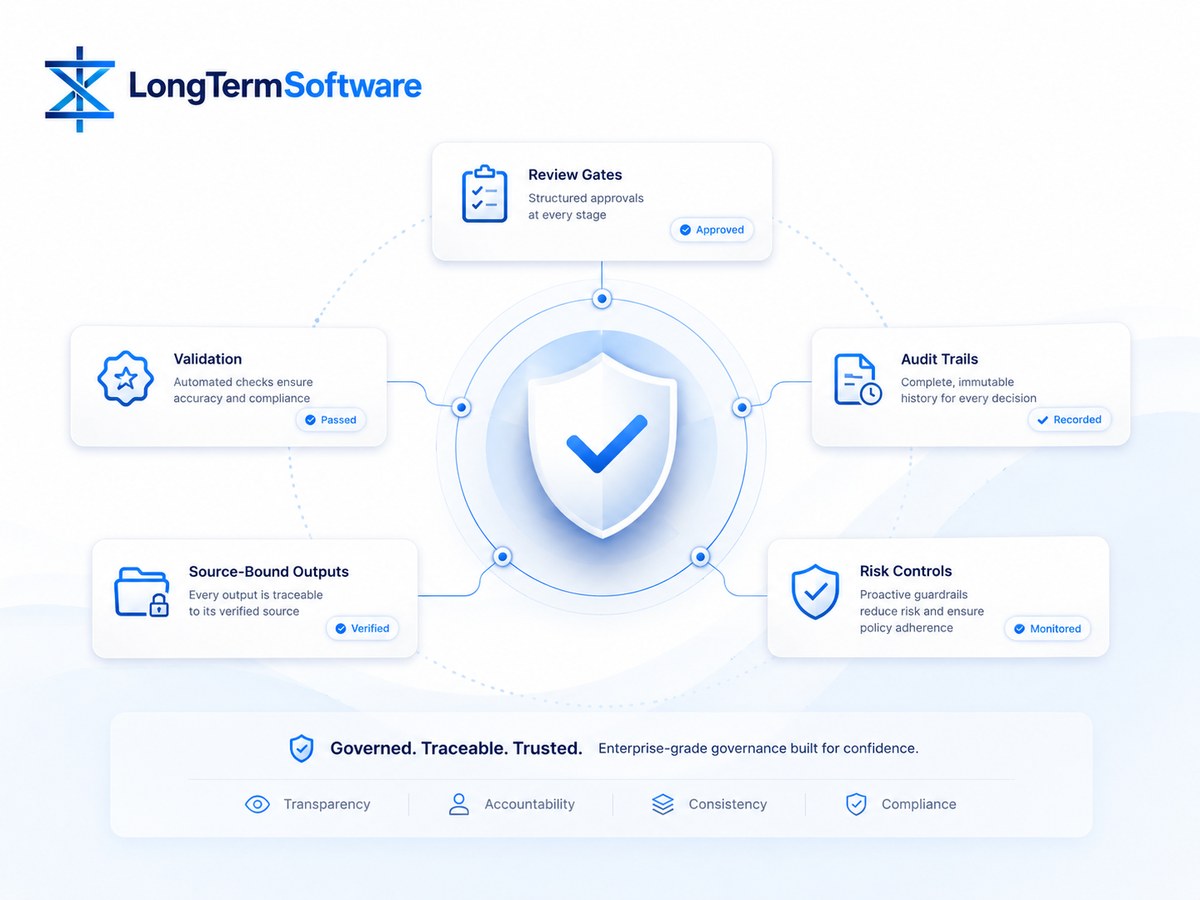
Human-in-the-loop AI is not a decorative approval button. It is a typed workflow in which evidence, review state, reviewer authority, rejection, blocked action, escalation, audit events, and downstream permissions are designed before production use.
Who this guide is for
Teams evaluating AI for documentation, operations, claims, analysis, support, or knowledge work where unreviewed output could affect customers, regulated data, or business decisions.
These solution pages use conventional search and procurement language to explain the buyer problem. The productized service pages remain the source of current package scope, timelines, and pricing floors.
Common buyer signals
When this problem usually needs structured architecture work
The examples below are common patterns, not claims about a specific client or guarantee that every environment requires the same response.
The workflow has no explicit distinction between draft, approved, rejected, blocked, and escalated states.
Model output can trigger downstream actions without a named human owner or least-authority boundary.
Teams lack fallback rules when sources are missing, confidence is low, or required evidence conflicts.
Technical approach
Reduce risk with explicit evidence, boundaries, and release decisions
- Define allowed sources, output schema, refusal behavior, and prohibited downstream actions.
- Design reviewer roles, typed states, source checks, edit history, escalation, and audit events.
- Pilot one bounded workflow with representative cases, failure examples, and explicit fallback behavior.
- Measure reviewer agreement, blocked actions, source support, and downstream defect signals before expansion.
Expected engagement outcomes
- Prompt and source contract with typed output rules.
- Reviewer workflow, approval states, and blocked-action model.
- Audit-event specification and escalation path.
- Pilot acceptance criteria and measurement plan.
Related packages and evidence
Move from category research to a concrete starting scope
Review the related service, public-safe case narrative, and buyer resource before sharing private system details.
Human-Reviewed AI Workflow Accelerator
AI Reviewer App MVP
AI Evaluation and Reliability Program
Related case narrative
Related buyer resource
Frequently asked questions
Questions buyers use to qualify this solution area
Does human review make every AI workflow safe?
No. Review only helps when reviewer authority, evidence visibility, workload, failure states, and downstream permissions are designed and tested for the actual workflow.
Can the workflow use local models?
Local, private, hybrid, or managed model options may be appropriate depending on data sensitivity, integration constraints, evaluation results, cost, and operational support requirements.
What should AI be blocked from doing by default?
High-impact production writes, privileged actions, unsupported compliance claims, publication without evidence, and actions outside a named authority boundary should remain blocked until explicitly designed and approved.
Next step
Confirm whether the problem fits before sharing sensitive system details.
Use a short fit call to identify the likely assessment or package. Public forms should not contain source code, credentials, PHI, customer records, financial records, or confidential production architecture.