
Solution guide
Legacy Software Modernization for .NET and SQL Systems
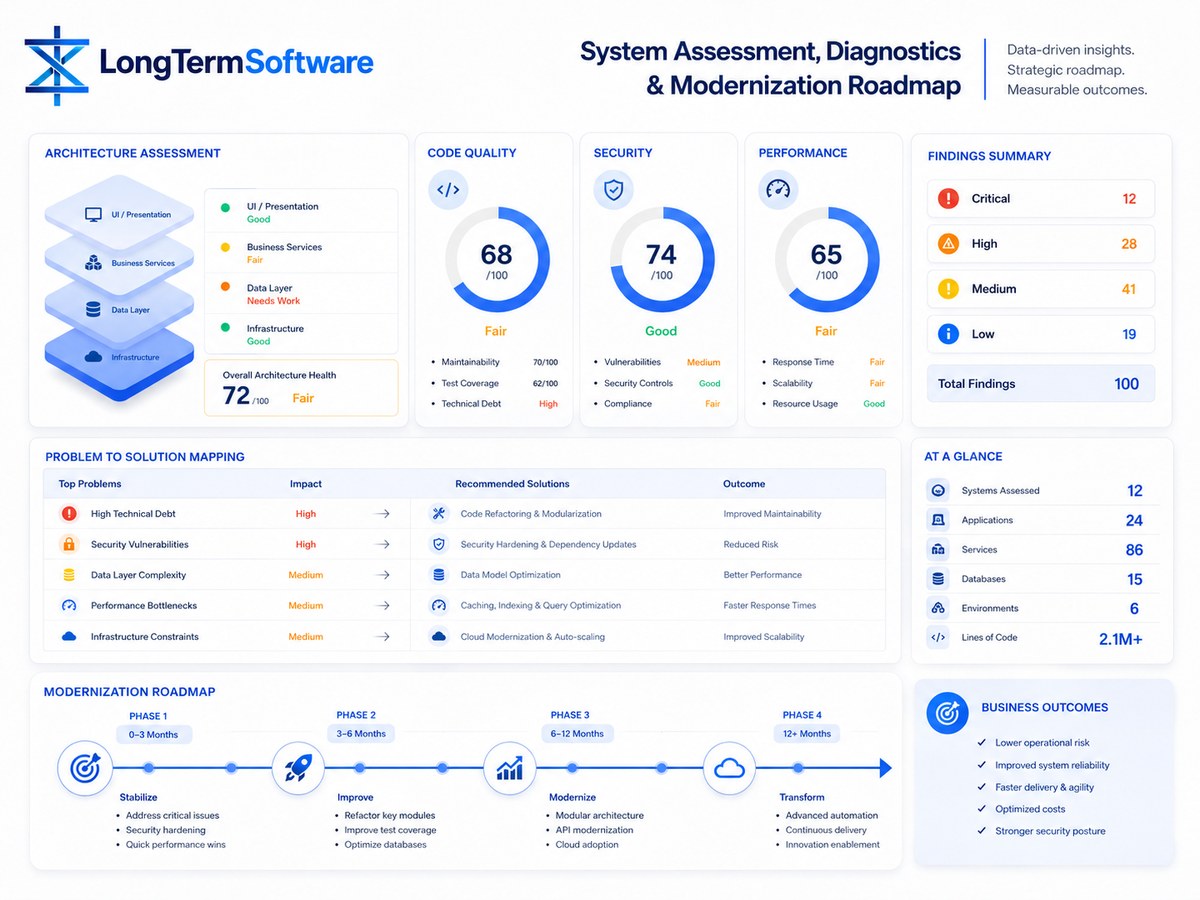
LongTermSoftware helps technical teams understand what a legacy system actually does before deciding what to replace. The work maps SQL-side rules, workflow states, reports, integrations, and representative parity scenarios so modernization can proceed in bounded, testable stages.
Who this guide is for
Engineering leaders responsible for business-critical legacy software where an unmeasured rewrite could change calculations, permissions, approvals, or operational workflow behavior.
These solution pages use conventional search and procurement language to explain the buyer problem. The productized service pages remain the source of current package scope, timelines, and pricing floors.
Common buyer signals
When this problem usually needs structured architecture work
The examples below are common patterns, not claims about a specific client or guarantee that every environment requires the same response.
The current application works, but test coverage does not describe business behavior well enough to support replacement.
Teams cannot identify safe API seams because database logic and UI behavior are tightly coupled.
Modernization pressure is high, but rollback, comparison, and staged release criteria remain undefined.
Technical approach
Reduce risk with explicit evidence, boundaries, and release decisions
- Inventory observable behavior, owners, integrations, and high-risk database dependencies.
- Map SQL-side calculations, approval paths, report logic, permissions, and exception states.
- Select representative parity scenarios and define how current and replacement paths will be compared.
- Identify service seams and sequence a modernization backlog around explicit rollback and acceptance criteria.
Expected engagement outcomes
- Legacy behavior map and unresolved-question register.
- Parity test plan and comparison strategy.
- API seam candidate matrix and staged migration backlog.
- Risk-ranked modernization roadmap with explicit release gates.
Related packages and evidence
Move from category research to a concrete starting scope
Review the related service, public-safe case narrative, and buyer resource before sharing private system details.
AI and Modernization Assessment
.NET / SQL Modernization Blueprint
Related case narrative
Related buyer resource
Frequently asked questions
Questions buyers use to qualify this solution area
Does legacy modernization require a full rewrite?
No. The preferred path is to document current behavior, introduce testable seams, and move bounded capabilities incrementally when that reduces operational risk.
How is SQL Server logic handled?
Stored procedures, jobs, reports, transactions, data ownership, and representative business scenarios are treated as application behavior rather than as an implementation detail.
Can you guarantee zero regression?
No general guarantee is made. The engagement defines measurable parity coverage, known gaps, acceptance criteria, rollback paths, and evidence needed for a scoped release decision.
Next step
Confirm whether the problem fits before sharing sensitive system details.
Use a short fit call to identify the likely assessment or package. Public forms should not contain source code, credentials, PHI, customer records, financial records, or confidential production architecture.